
The Payload Ceiling: Why Half-Ton Trucks Run Out of Payload Before Towing Capacity
A half-ton truck usually runs out of payload long before it reaches the tow rating on the window sticker. The two numbers are calculated separately, and the lower one decides what you can legally and safely carry.
Payload is the weight a truck can carry: passengers, tools, cargo, and the tongue weight of a trailer. Subtract curb weight from the gross vehicle weight rating (GVWR) and you have it. Towing capacity is the heaviest trailer a truck is built to pull, measured against the gross combined weight rating (GCWR).
Those tow ratings come from a stripped-down truck: base trim, one light driver, a full tank, and nothing else aboard. Every passenger, hitch, bed liner, or piece of trailering gear you add eats into payload and leaves less room for tongue weight. Because tongue weight runs 10 to 15 percent of trailer weight, it draws that payload down fast.
The result is easy to miss. A truck rated to tow 12,000 pounds may have only 1,500 pounds of payload. A family, their gear, and a heavy tongue can blow past that limit while the trailer stays well under its tow ceiling. Shop by tow rating alone and you can overload the truck without knowing it.
This article walks through how both ratings are calculated, where the bottleneck really is, and how to compare half-ton trucks with the best towing capacity so the rig you build actually meets your needs.
Understanding Payload Capacity: GVWR, Curb Weight, and the Real Numbers
Every half-ton on the lot carries two ratings, and they are easy to mix up. Before you trust the big tow number, understand the one that runs out first: payload capacity.
The arithmetic is simple: payload capacity = GVWR − curb weight. Passengers, gear, the hitch, and the trailer’s tongue weight all have to fit inside that one number.
What GVWR Actually Means
GVWR (gross vehicle weight rating) is the most the loaded truck may weigh. The manufacturer sets it and stamps it on the driver’s-side door jamb. It is not a towing figure. It caps the truck itself: the vehicle, all fluids, passengers, cargo, and any tongue weight pressing on the hitch.
What Curb Weight Actually Means
Curb weight is the truck as it leaves the line: all fluids at full capacity, a full tank of fuel, and standard equipment, with no driver, passengers, or cargo. What remains between GVWR and curb weight is the payload you can actually use.
Why Two Identical Trucks Carry Different Payloads
This is where buyers get caught out. Two trucks with the same nameplate can post very different payloads, because every option adds curb weight while GVWR stays put. The usual culprits:
- Cab and bed configuration – a Crew Cab 4×4 short box is far heavier than a Regular Cab 2WD long box.
- Drivetrain – four-wheel drive adds hundreds of pounds of transfer case and front axle hardware compared with two-wheel drive.
- Trim level – leather, power everything, sunroofs, and upgraded audio all add mass.
- Engine choice – a diesel engine is substantially heavier than its gasoline counterpart, often cutting available payload significantly on the very trucks buyers assume are the most capable.
The engine point catches a lot of shoppers. A diesel can give up well over a thousand pounds of payload against its gas sibling even though it tows more. Before you sign, read the door-jamb sticker on the exact truck you want, not the brochure.
When you compare candidates, put the sticker payload next to your real tongue weight and passenger load instead of the headline. That comparison matters more than the biggest number on the spec sheet.
So the first limit you hit is usually payload, not towing capacity. Know your GVWR, know your curb weight, and do the subtraction yourself.
How Payload Fits Inside GVWR (And Why GCWR Is a Separate Cap)
Payload is not a separate allowance sitting beside your truck’s weight rating. It is a slice inside of it. The diagram below shows how the two ratings stack.
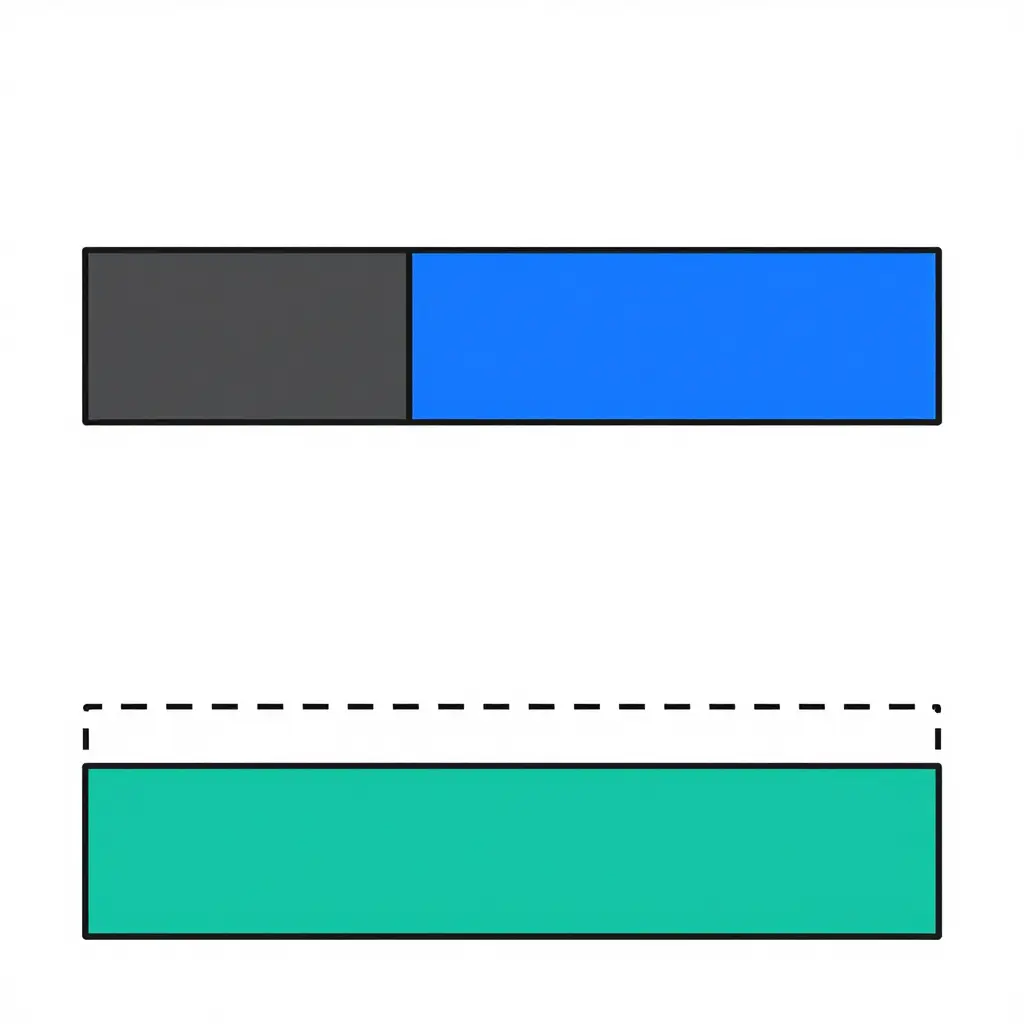
The top bar is GVWR. Curb weight takes the left segment; available payload is what remains on the right. That leftover slice is all the room you have for passengers, tools, tongue weight, and anything else you put on the truck. Fill it and the bar is full; go past it and you are over GVWR no matter what the brochure says you can tow.
The bottom bar is a different ceiling. GCWR (gross combined weight rating) caps the truck and the loaded trailer together. That is how a truck can show an impressive tow number while its payload slice stays thin. Each bar has its own limit, and the smaller one is what stops you.
Why This Matters In Practice
- GVWR limits what you put on the truck (people, gear, hitch weight).
- GCWR limits what the truck and trailer weigh together.
- Towing capacity assumes a nearly empty truck, so real-world payload disappears fast once occupants and tongue weight add up.
When you compare rigs, look past the headline tow rating at how much payload you keep. That usable margin is what decides the trailer you can actually pull.
Why the Advertised Towing Capacity Is Misleading
Every half-ton advertisement leads with a five-digit towing capacity and the implication that any trailer is fair game. In practice that number is a best-case ceiling, not a realistic limit, and the gap between the badge and the driveway is where owners get into trouble.
How Tow Ratings Are Actually Validated
Manufacturers validate maximum tow ratings under the SAE J2807 standard, a controlled engineering test rather than a simulation of daily driving. The test vehicle is set up with:
- A base trim equipped with the most capable drivetrain, axle ratio, and cooling package
- One driver and no passengers
- A full tank of fuel and minimal cargo
- No aftermarket accessories such as bed liners, tonneau covers, or toolboxes
- In many cases, a weight-distributing hitch to stabilize and redistribute the load
None of that matches the truck you actually own. Add a family of four, a bed full of gear, and a cab full of tools, and usable capacity shrinks quickly. The same mismatch explains why ratings are calibrated so differently across truck segments; comparing how those figures are set from one size class to the next is worth the read before you buy.
GCWR and the Real Governing Limit
What really controls your towing is the GCWR (gross combined weight rating), the most the loaded truck and loaded trailer may weigh together. A truck’s maximum tow rating is roughly its GCWR minus its own base weight. Add passengers, fuel, and cargo, and the truck’s actual weight climbs, so less is left over for the trailer. Chase the advertised number without checking GCWR and you are towing blind.
Tongue Weight Eats Payload
Tongue weight catches owners off guard. A conventional trailer puts roughly 10 to 15 percent of its total weight on the hitch and rear axle of the tow vehicle. That load is not shared with the trailer; it lands on the truck and counts against payload. A 7,000-pound trailer, for example, can drop 700 to 1,050 pounds on the truck before a single passenger or bag of luggage is aboard.
The physics is simple: payload runs out long before the advertised tow rating does. The number on the brochure describes a stripped test truck, not the loaded one in your driveway.
The brochure pushes tow numbers, but the real ceiling is almost always payload. The table below covers five popular 2024 configurations: curb weight, GVWR, factory payload, maximum rated towing, and the trailer weight you can realistically pull once tongue weight and passengers come out of payload.
| Model / Trim | Curb Weight (lb) | GVWR (lb) | Payload Capacity (lb) | Max Rated Towing (lb) | Estimated Real-World Tow Limit (Payload-Limited) (lb) |
|---|---|---|---|---|---|
| Ford F-150 XLT SuperCrew 4×4 (3.5L EcoBoost V6) | 5,200 | 7,050 | 1,850 | 13,200 | ~10,400 |
| Chevrolet Silverado 1500 LT Crew Cab 4×4 (5.3L V8) | 5,290 | 7,100 | 1,810 | 11,000 | ~10,100 |
| RAM 1500 Laramie Crew Cab 4×4 (5.7L HEMI V8) | 5,500 | 7,100 | 1,600 | 11,500 | ~8,500 |
| Toyota Tundra Limited CrewMax 4×4 (3.4L Twin-Turbo V6) | 5,600 | 7,300 | 1,700 | 11,000 | ~9,200 |
| GMC Sierra 1500 SLT Crew Cab 4×4 (5.3L V8) | 5,330 | 7,100 | 1,770 | 11,000 | ~9,800 |
Payload, not the tow rating, is usually the binding constraint. Subtract passengers, gear, and the trailer’s tongue weight from payload and the trailer you can legally and safely pull often lands well below the advertised figure, even when half-ton truck towing capacity ratings suggest otherwise.
Why Payload Becomes the Binding Constraint
Half-tons are sold on maximum tow ratings, and those headline numbers hide the limit that stops most owners: payload. Every pound of tongue weight, passenger, and cargo lands on the truck’s springs, axles, and tires. Do the math and it becomes obvious why a half-ton towing a trailer runs out of payload long before it ever nears its rated tow capacity.
Start with the trailer. A travel trailer with a 7,000 lb GVWR puts 10-15% of its total weight on the hitch as tongue weight: 700 lb at 10% and 1,050 lb at 15%. The trailer’s own axles carry its gross weight, but tongue weight presses straight down on the truck through the receiver and rear suspension.
Then add the truck’s own load. Passengers, fuel, gear, and accessories all draw on the same finite payload budget:
| Payload line item | Typical weight |
|---|---|
| Trailer tongue weight (12% of 7,000 lb) | 840 lb |
| Driver plus three passengers | 600 lb |
| Full tank of fuel | 150 lb |
| Tools, cooler, and generator | 200 lb |
| Hitch, bed liner, and tonneau cover | 120 lb |
| Total payload consumed | 1,910 lb |
Against a typical half-ton payload rating of 1,500-1,800 lb, that combination blows the budget with room to spare. Even a lean load – 840 lb of tongue weight, 400 lb of passengers, 150 lb of fuel, and 100 lb of gear – uses 1,490 lb and leaves almost nothing for one more bag.
This is where the trap closes. The trailer can stay comfortably under the truck’s maximum tow rating while the truck still exceeds its payload and rear axle ratings, because the tongue weight and everything else pile onto one set of axles. Towing capacity is what the truck can pull; payload is what it can carry while pulling, and the two limits are not the same thing.
In a half-ton truck towing setup, payload – not the max tow number – is almost always the first rating you exceed, and tongue weight is the single heaviest fixed load driving that result.
Payload-Limited Towing: Why the Rated Number Rarely Matches Reality
Every half-ton on the lot wears a big “Max Towing” number on the window sticker. That number sells trucks, and for almost every owner it is unreachable the moment the truck is actually loaded for a trip. The reason is simple physics: you run out of payload long before you run out of towing capacity.
The chart below pairs two bars for five popular half-ton models. The lighter bar is the advertised max rated towing capacity. The darker bar is the realistic tow limit once payload constraints – passengers, cargo, hitch hardware, and trailer tongue weight – are accounted for.
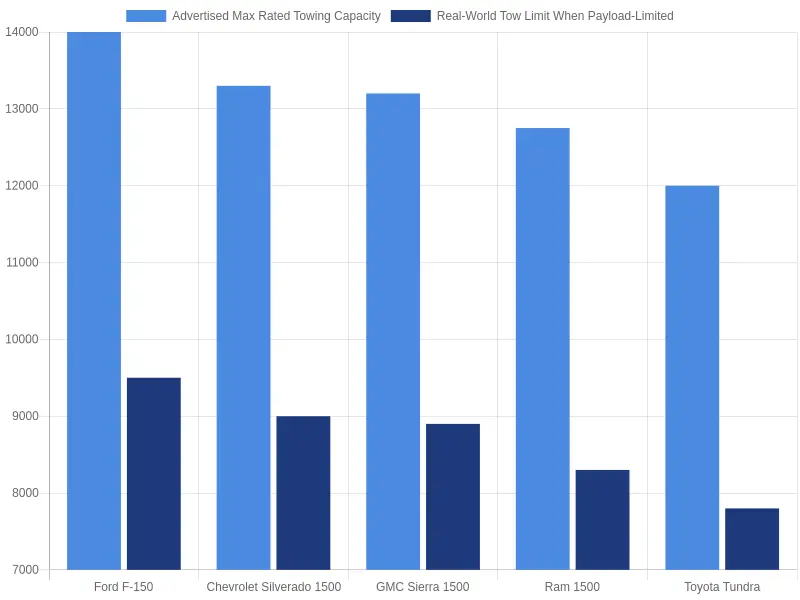
Every model shows a substantial gap. This is not a manufacturer trick: the towing rating is a genuine mechanical ceiling set by the engine, transmission, axle, and cooling package. The catch is that the same truck also has a hard payload ceiling, and a heavy trailer’s tongue weight eats straight into it.
The Five Models, Side by Side
The chart’s underlying dataset is below. The numbers are rounded and reflect typical, well-equipped configurations rather than the stripped single-cab press-fleet build that produces the headline rating.
| Truck Model | Advertised Max Rated Towing (lbs) | Real-World Payload-Limited Tow Limit (lbs) | Gap (lbs) |
|---|---|---|---|
| Ford F-150 | 14,000 | 9,500 | 4,500 |
| Chevrolet Silverado 1500 | 13,300 | 9,000 | 4,300 |
| GMC Sierra 1500 | 13,200 | 8,900 | 4,300 |
| Ram 1500 | 12,750 | 8,300 | 4,450 |
| Toyota Tundra | 12,000 | 7,800 | 4,200 |
How to Read the Gap
The advertised figure assumes a base truck with a driver and essentially nothing else. Add the things that make a half-ton useful – a crew cab, four-wheel drive, a sunroof, a bed liner, a toolbox – and payload drops. Then load it for a real trip:
- Passengers and gear: a family of four plus luggage can easily consume 600 to 800 lbs.
- Hitch hardware: a weight-distributing hitch and sway control add roughly 100 lbs.
- Trailer tongue weight: conventional travel trailers place about 10 to 15 percent of their gross weight on the hitch.
Run the numbers and the pattern holds. A truck with 1,750 lbs of available payload, minus 700 lbs of people and cargo, minus 100 lbs of hitch gear, leaves around 950 lbs for tongue weight. At a 12 percent tongue-weight ratio, that supports a trailer of only about 7,900 lbs – thousands of pounds below the 14,000 lbs the marketing declared.
The pattern repeats: payload, not towing capacity, is the binding constraint on most half-ton setups. If you are comparing models for a future purchase, look past the headline towing number and check the payload sticker in the driver’s door jamb. Then stack the models up tradeoff by tradeoff.
The Practical Takeaway
Whether you are shopping or loading up, work backward from payload rather than forward from the towing rating:
- Find your truck’s actual payload from the door-jamb sticker – not a brochure.
- Subtract every person, pet, and pound of cargo you will carry.
- Subtract hitch hardware.
- Divide the remainder by your trailer’s tongue-weight percentage to find the heaviest trailer you can safely pull.
Do that, and the darker bars in the chart stop being a surprise and start working as a checklist.
What Eats Into Your Payload Budget
Your payload budget is the difference between your truck’s gross vehicle weight rating (GVWR) and its curb weight, and it disappears faster than most owners expect. Every item you add competes for the same limited capacity, and they stack up before you ever hook up a trailer. These are the factors that quietly eat your half-ton payload.
- Passengers – Every occupant, the driver included, counts against payload, and a family of four can easily consume 600 pounds or more before anyone loads a bag.
- Trailer tongue weight – The downward force a hitch-mounted trailer puts on your truck typically runs 10 to 15 percent of the trailer’s gross weight, so a 7,000-pound travel trailer adds roughly 700 to 1,050 pounds.
- Aftermarket accessories – Heavy-duty bumpers, winches, and lift kits add serious mass, with a steel front bumper and winch combo often tipping the scale at 250 pounds or more.
- Cab and bed cargo – Groceries, luggage, work equipment, and gear all subtract from available payload, whether they sit behind the seat or in the bed.
- Fuel and fluids – A full tank of gas can weigh around 150 pounds, and larger tanks or auxiliary fuel systems push that figure higher.
- Weight-distributing and hitch hardware – A weight-distributing hitch, ball mount, and sway-control hardware can add 75 to 150 pounds of permanent load.
- Toolboxes – A loaded bed toolbox packed with tools commonly weighs 100 to 300 pounds, and it sits in your truck whether you need it or not.
- Cooler and gear loads – A full cooler, camp chairs, firewood, and recreational gear can silently cost you another 100 to 200 pounds every trip.
Each factor looks manageable in isolation, but together they compound fast. Stack them up and your real-world payload budget is gone long before your truck ever approaches its rated towing capacity, leaving you overloaded on paper and on the road.
Doing the Real-World Towing Math
The gap between the half-ton truck towing capacity printed on a window sticker and the trailer you can actually pull safely comes down to a short subtraction problem. Work it in order, using numbers you can verify on your own truck rather than the best-case figures in a brochure.
-
Read the payload sticker. Open the driver’s door and find the yellow-and-white payload sticker on the door jamb. That number, commonly 1,300 to 1,800 lbs on a half-ton truck, is your real cargo-and-hitch budget as equipped, with the cab, options, and axle you actually drive. Brochure ratings are computed on a stripped base truck with a 150-lb driver and a single tank of fuel, so they rarely match the vehicle in your driveway.
-
Subtract passengers. Add the actual weight of every occupant, including yourself. Two adults and two children typically run about 500 lbs. Kids grow and their gear multiplies, so weigh the crew instead of estimating.
-
Subtract fuel, or keep it as margin. Gasoline weighs roughly 6.3 lbs per gallon. A 26-gallon tank carries about 164 lbs of fuel; a 36-gallon tank pushes past 220 lbs. Confirm whether your rating already assumes a full tank before treating fuel as “free.” Most door-jamb payload numbers already include one, so this step is best read as a safety margin rather than a strict deduction.
-
Subtract gear. Toolboxes, generators, coolers, firewood, bikes, and cab clutter all ride on payload. A modest load of camp and work gear easily reaches 250 lbs.
-
Subtract hitch hardware. A weight-distributing head, spring bars, and ball mount add 75 to 150 lbs of dead weight before the trailer is attached. Use 100 lbs as a working figure.
-
Work out the tongue weight limit. Whatever payload remains after steps 2 through 5 is your maximum allowable tongue weight: 1,700 − 500 − 164 − 250 − 100 = 686 lbs.
-
Convert that to a maximum trailer weight. Conventional trailers need 10 to 15 percent of their gross weight on the tongue to resist sway. Divide the tongue weight limit by that percentage. At 12 percent: 686 ÷ 0.12 ≈ 5,717 lbs. At a conservative 15 percent: 686 ÷ 0.15 ≈ 4,573 lbs.
Worked Example Summary
| Line item | Weight (lbs) |
|---|---|
| Payload sticker (door jamb) | 1,700 |
| Passengers (2 adults, 2 kids) | -500 |
| Fuel (26 gal x 6.3) | -164 |
| Gear and tools | -250 |
| Hitch hardware | -100 |
| Remaining = tongue weight limit | 686 |
| Max trailer weight at 12% tongue | ~5,717 |
| Max trailer weight at 15% tongue | ~4,573 |
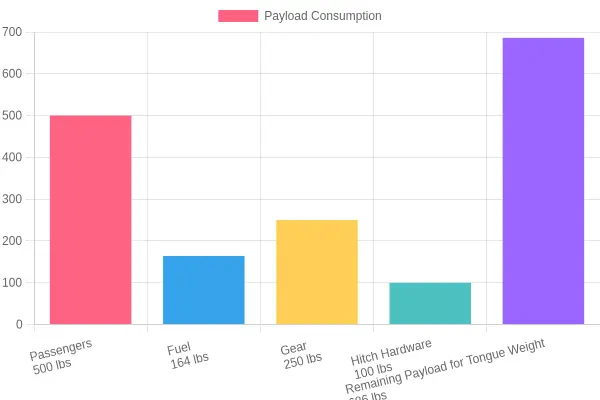
Fuel stays in the subtraction above as a deliberate cushion. If your sticker already assumes a full tank, drop that 164 lbs and the numbers improve. Either way, the ceiling is set by tongue weight. This truck might carry a headline rating north of 9,000 lbs, yet the math caps it near 5,700 lbs of trailer. That is the real lesson of the payload sticker: tongue weight sets your true ceiling, not the advertisement. Knowing how the numbers interact is the difference between a confident tow and an overloaded axle, and it is the same discipline that should guide the truck you buy. Run the subtraction before you sign, not after you hitch up.
How to Determine Your Truck’s True Towing Limit Before You Buy or Hook Up
Determining real towing capability starts with the paperwork on your truck, not the brochure. The advertised tow rating is a marketing maximum, calculated with a base-model truck, a 150-pound driver, and nothing else on board. Your truck rarely leaves the lot that way.
Start With the Door-Jamb Payload Sticker
Open the driver’s door and find the certification label. It lists GVWR, front GAWR, rear GAWR, and the vehicle’s official payload limit. That single number – your available payload – is the ceiling. It already accounts for a full tank of fuel and a driver; every passenger, cooler, and ounce of tongue weight subtracts from it.
Weigh the Truck at a Scale
Take the truck to a certified CAT scale and weigh it as it sits, fuel included. This confirms the actual curb weight, which often runs 300 to 500 pounds heavier than spec because of options, bed liners, and aftermarket add-ons. Subtract curb weight from GVWR to find your true leftover capacity.
Weigh the Loaded Truck and Trailer
Hook up the trailer, load it, then weigh again. Capture three figures: steer axle, drive axle, and trailer axle. This reveals whether tongue weight is pushing your rear axle past its rating.
Compare Against GVWR and Rear GAWR
Two limits trap most owners. GVWR caps total truck weight. Rear GAWR caps the load on the rear axle, and it is usually the first to fail. A trailer can sit within its own GVWR yet still overstress the truck’s rear GAWR.
Options and Trim Change Everything
On a half-ton truck, every upgrade eats payload. Four-wheel drive, a crew cab, a diesel, a sunroof, running boards, and leather all add pounds, while a higher trim level can drop the payload rating by 1,000 pounds or more. Two trucks with the same engine can differ by hundreds of pounds of usable capacity. When you pick a truck for towing work, study those trade-offs, as detailed in this guide on choosing a tow truck you won’t outgrow.
Run the numbers before you sign or hook up. The sticker and the scale never lie.
Frequently Asked Questions About Half-Ton Payload and Towing Capacity
Does payload capacity limit towing capacity?
They are separate ratings, but they meet at tongue weight. When you tow a trailer, its tongue weight counts against your truck’s payload capacity, so a half-ton with a generous towing rating can still be payload-limited once passengers, cargo, and hitch weight are added. Compare half-ton trucks with the best towing capacity before you buy.
Can I tow more by adding air bags or a weight-distributing hitch?
Air bags and weight-distributing hitches improve stability and level the ride, but they do not increase legal ratings. Your half-ton truck’s payload capacity and towing capacity remain set by the manufacturer’s GVWR and GCWR. Exceeding those limits can still overload axles, brakes, and tires even if the truck looks level.
What is the difference between GVWR and GCWR?
GVWR (Gross Vehicle Weight Rating) is the maximum your truck alone can weigh, including passengers, fuel, and cargo. GCWR (Gross Combined Weight Rating) is the maximum combined weight of the loaded truck plus the trailer. Payload capacity derives from GVWR, while towing capacity is governed primarily by GCWR.
Why does my truck’s payload sticker show less than the brochure?
The brochure figures reflect a base, stripped model, while your door-jamb sticker lists the actual payload capacity for that specific build. Options like a diesel engine, four-wheel drive, a sunroof, or a heavier trim add weight and reduce available payload. Accessories installed after purchase reduce it further.
How much tongue weight can a half-ton truck carry?
Tongue weight typically runs 10 to 15 percent of a trailer’s total weight. A travel trailer weighing 7,000 pounds therefore places roughly 700 to 1,050 pounds on the hitch, and that amount counts against payload capacity. Many half-ton trucks have 1,300 to 1,900 pounds of payload, leaving little room once passengers and gear are loaded.
Is it safe to exceed payload if I am under the tow rating?
No. Staying under the tow rating does not guarantee safety, because payload capacity covers everything the truck carries, including tongue weight. Exceeding it can overload the rear axle, brakes, and tires, exceeding the truck’s GVWR. That increases stopping distances and can void warranty coverage or create legal liability.
The Takeaway: Payload, Not Towing Rating, Sets the Real Limit
Across every spec sheet, sticker, and scale reading in this article, one conclusion holds: a half-ton truck payload runs out long before the vehicle ever approaches its rated towing capacity. The headline number dealers love to quote is a best-case ceiling measured on a stripped truck, not the real-world limit of the rig you actually drive. What binds is almost always how much weight you can carry, not how much you can pull.
Three practical actions should anchor every towing decision:
- Check the door-jamb payload sticker on your specific truck, not the brochure. Options, cab configuration, and trim all cut into that number.
- Account for tongue weight and cargo. Trailer tongue load, passengers, fuel, and gear all draw from the same payload budget before you ever hitch up.
- Weigh the loaded rig at a CAT scale to confirm both axle loads and gross vehicle weight stay within their ratings.
Evaluating payload, GVWR, and rear axle ratings first turns truck selection into an engineering exercise rather than a marketing one. It also points buyers toward configurations that genuinely match their trailers. For a deeper look at how these figures interact, see this guide to understanding half-ton towing specs.
As trailers get heavier and half-tons get more capable on paper, matching verified specs to real towing needs is what keeps an owner out of trouble, with payload as the deciding factor every time.