

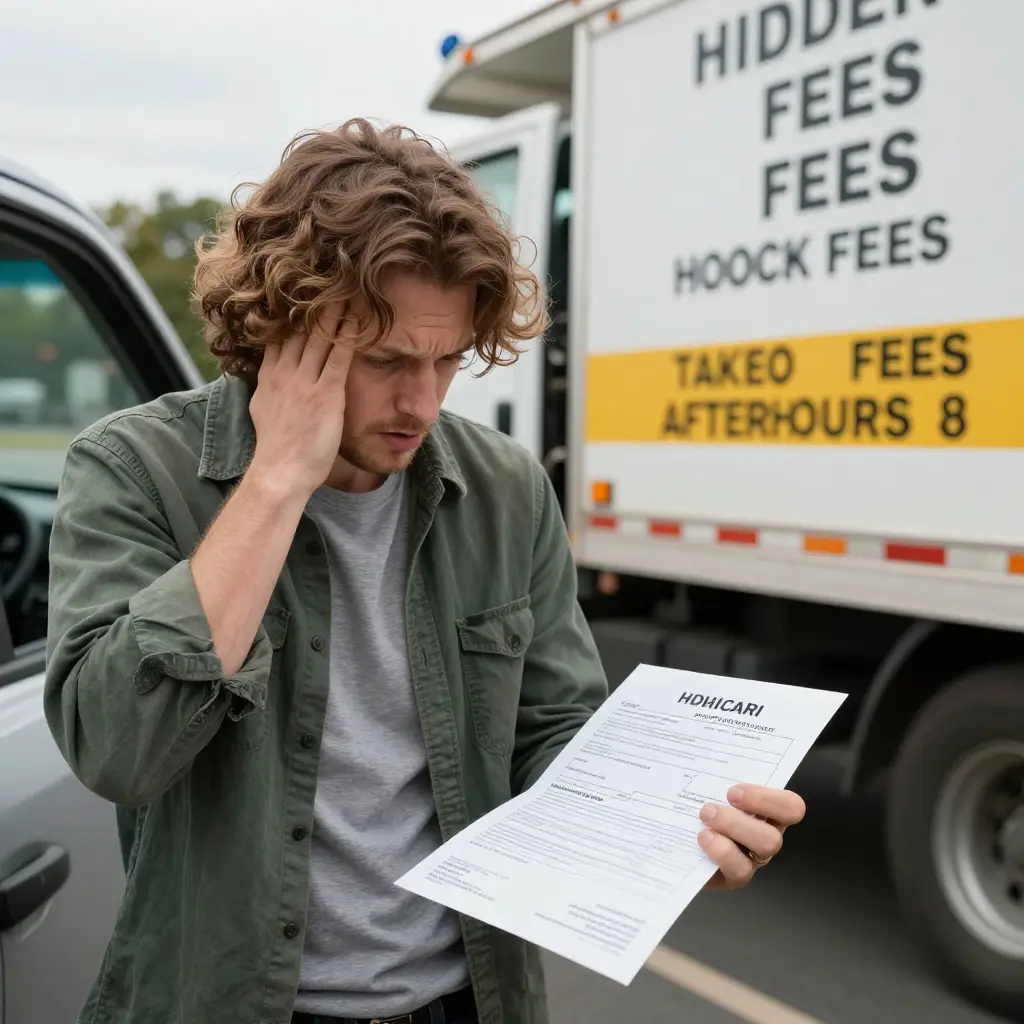
Why Low Cost Tow Truck Service Quotes Hide the Real Bill
Call for a tow and the price you hear on the phone is rarely the price you pay. Two charges account for most of the gap: the hook fee and the after-hours rate. Neither shows up in the headline number.
A hook fee is the flat charge for attaching your vehicle to the truck, billed before anyone counts miles. An after-hours rate is the higher charge applied when a truck is dispatched at night, on a weekend, or on a holiday.
Neither charge is illegal, and neither is unfair by itself. The trouble is disclosure. A dispatcher quotes a base price that leaves out both, so a “$65” estimate reaches $185 by the time the truck pulls away. The low number wins the phone call; the add-ons collect the margin.
Cheap headline pricing doesn’t lower the cost of towing. It moves that cost into line items you see only after the wheel is off the ground, when the decision is already made.
Knowing how low-cost tow pricing is actually structured is the only way to challenge a fee you never expected.
What Exactly Is a Hook Fee?
A hook fee is a flat, one-time charge for the physical work of attaching, or “hooking,” your vehicle to the wheel lift, winch, or flatbed before it moves an inch. It is not a tip or a courtesy, and it is rarely part of the advertised headline price. It is also the line item most likely to turn an eye-catching quote into a larger bill. When one company’s quote is dramatically cheaper than every competitor’s, the hook fee is usually where the missing money comes back. That pattern is common in low-cost towing quotes that bury the hook fee, so ask about it up front.
When a Hook Fee Typically Applies
It is charged the moment the driver starts securing your vehicle. In practice, that means:
- The driver connects a winch cable, wheel lift, or flatbed strap to your vehicle
- Your car is stuck in mud, snow, sand, or a ditch and needs extra rigging or a second attempt
- The vehicle sits in a tight garage, narrow alley, or awkward parallel spot that demands repositioning
- The car has no keys, is locked in gear, or has seized wheels, requiring dollies or skates
- A flat tire, bent axle, or collision damage prevents the vehicle from rolling onto the bed
- Dispatch happens after hours, on a weekend, or on a holiday and triggers a call-out
How the Hook Fee Differs From the Base Rate and Mileage Charge
Three charges, three different jobs. Mixing them up is how invoices get confusing.
| Charge | What It Pays For | How It Is Calculated |
|---|---|---|
| Hook fee | Attaching the vehicle to the truck | Flat fee, once per hook |
| Base towing rate | Dispatch, driver labor, and the first included mile | Flat fee per call |
| Mileage charge | Distance traveled beyond the included mile | Per-mile rate |
The base rate pays for the truck showing up and the first leg of the tow. Mileage scales with distance. The hook fee is a separate, fixed labor charge for the hook itself. A straight operator puts all three in front of you before you agree to service.
The Bottom Line for You
Before you authorize a tow, ask the dispatcher for three separate numbers: the hook fee, the base rate, and the per-mile charge. Compare the totals, not the headlines. A quote that hides its hook fee is not a cheaper tow, just a delayed one.
Defining the After Hours Rate: The Fee Behind the “Low” Quote
An after hours rate is the surcharge a provider adds when a job falls outside normal business hours – nights, weekends, public holidays. It sits on top of the base hook fee and the per-mile charge, and it is one of the first things left out of an unusually cheap advertised quote. That is why a number on a bright afternoon flyer rarely matches the one on your 2 a.m. invoice.
A daytime base rate assumes normal staffing, light traffic, and easy access to the vehicle. After-hours work breaks all three: it needs on-call drivers, premium labor, and more insurance exposure. Operators express that as a multiplier – commonly 1.5x to 2x the base – applied on top of the hook fee and mileage rate. It stacks with those charges rather than replacing them, which is standard practice across the industry.
| Charge component | Typical daytime | After hours (night/weekend/holiday) |
|---|---|---|
| Base hook fee | Standard | Multiplied (often 1.5x-2x) |
| Per-mile rate | Standard | Multiplied or held flat by contract |
| Winch-out / recovery | Standard | Stacks on top |
| Emergency dispatch callout | Usually not charged | Adds a fixed premium |
Because the multipliers compound, a job quoted at $75 can pass $200 once the after-hours rate, mileage, and recovery fees are added. The surcharge itself is legitimate – keeping a truck and driver on call around the clock costs real money – but leaving it out of an advertised quote is what catches stranded drivers off guard. Reputable providers disclose it; deep-discount advertisers bury it. When you compare operators, read the fine print for where the after-hours emergency dispatch disclaimer sits.
Before the truck rolls, ask two questions: “Is this the after hours rate?” and “does it stack with the hook and mileage fees?” Get the stacked total in writing. If you run a fleet, negotiate the after hours rate as a defined multiplier in the contract instead of accepting day-rate pricing that resets at sunset. Round-the-clock coverage is only worth paying for when you know what it costs.
How a Headline Tow Price Is Really Built
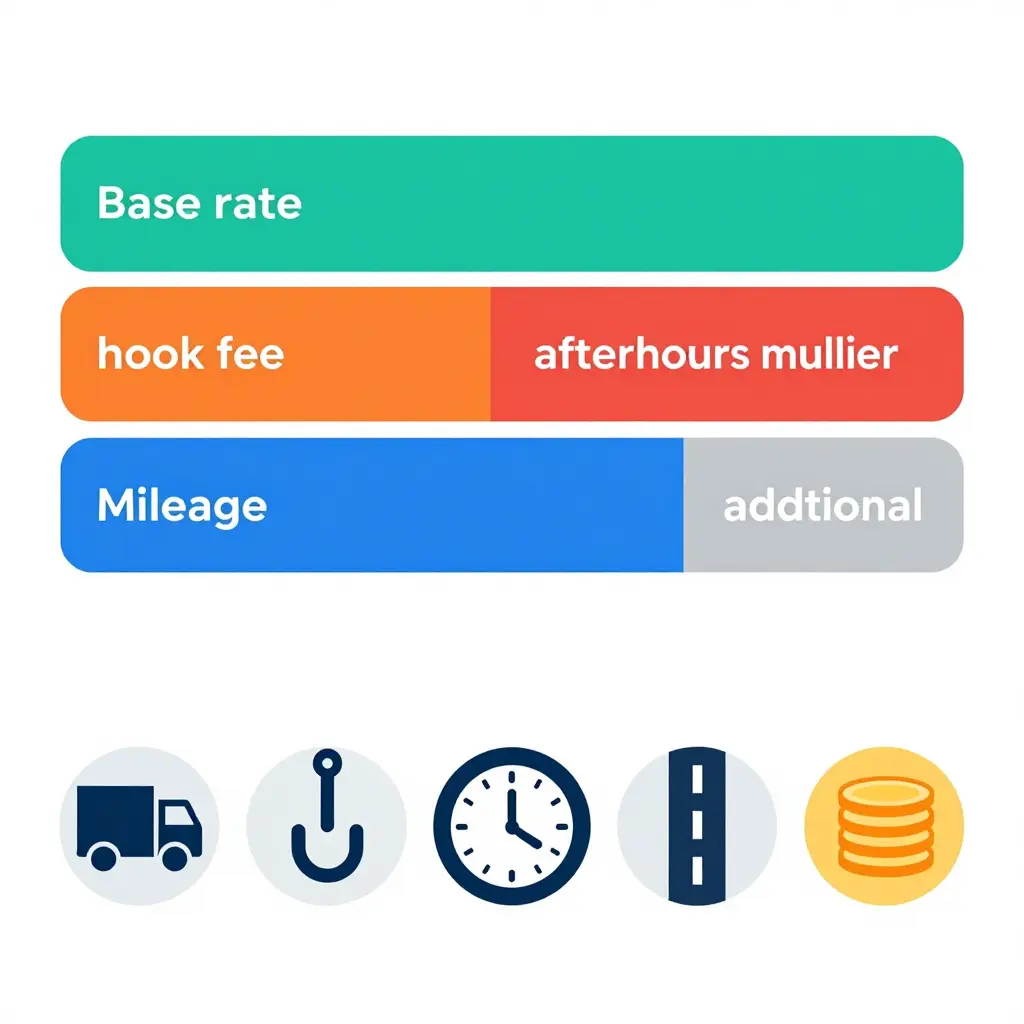
A low “starting at” quote covers one slice of the total bill. The diagram above splits a tow quote into its five moving parts:
- Base rate – the flat dispatch fee that gets quoted up front.
- Hook fee – the charge for securing and lifting your vehicle, often buried in the fine print.
- After-hours multiplier – the late-night, weekend, and holiday surcharge that quietly inflates every other line.
- Mileage – a per-mile charge that grows fast over long hauls.
- Additional charges – storage, winching, cleanup, and other add-ons that appear only at the end.
When a quote pushes only the base rate, the other four segments can carry the total well past what you expected. Ask for the itemized breakdown before you agree, and compare it with how reputable operators structure pricing. Our guide to transparent low-cost tow truck service shows the difference.
Quote vs. Final Invoice: Watch the Total Balloon
Line the advertised number up against the invoice and the trick is easy to see. The advertised price is built to look unbeatable, while the real charges stay invisible until your car is on the truck. Here is a typical late-night breakdown call.
| Fee Component | Advertised Quote | Final Invoice | Difference |
|---|---|---|---|
| Base rate | $45.00 | $45.00 | $0.00 |
| Hook fee | $0.00 (not disclosed) | $75.00 | +$75.00 |
| After-hours rate | $0.00 (not disclosed) | $65.00 | +$65.00 |
| Mileage charge | $0.00 (“first miles free”) | $60.00 | +$60.00 |
| Fuel / environmental fee | $0.00 (not disclosed) | $18.00 | +$18.00 |
| Total | $45.00 | $263.00 | +$218.00 |
Why the Total Explodes
The headline base rate of $45 is real, which is exactly what makes the trick work. The inflation happens entirely in the line items that never appear in the phone quote:
- The hook fee ($75). The most common buried charge in the industry. Attaching your vehicle is presented as a separate service, so it is billed on top of the base rate rather than included in it.
- The after-hours rate ($65). Breakdowns rarely happen during business hours, so this surcharge lands on almost every real-world call, yet it is left off the advertised figure.
- The mileage charge ($60). The quote implies the trip is covered, but once you pass the small free-mileage window, every extra mile is billed at a premium rate.
- The fuel or environmental fee ($18). A small-looking surcharge that pads the total and is almost never mentioned upfront.
Add it up and a $45 quote becomes a $263 invoice, a 484% increase. The $218 difference is exactly the sum of the added fees, so the arithmetic holds no matter how the operator tries to explain it away at the roadside.
The lesson is simple: never judge a tow service by the number you hear first. Ask for the hook fee, the after-hours rate, the mileage rate, and any environmental surcharges in writing before you agree to anything. If you want to see how these buried costs get used against customers, read this breakdown of why a low-cost tow truck service often costs you more.
How to Read and Compare Tow Truck Quotes
Stranded on the shoulder is the worst time to negotiate fine print, and it is exactly when pricing traps are easiest to miss. A “low cost” quote sounds reassuring, but the phone number rarely matches the invoice. Slow down, get everything in writing, and compare line by line instead of by the headline.
Always Request a Written, Itemized Quote
Never accept a single lump-sum price. Ask the dispatcher to send a written, itemized quote that breaks out every charge separately. A legitimate operator will have no problem doing this. If a company hesitates or insists the price is “all-inclusive” without detail, treat that as a warning sign.
Once you have itemized quotes in hand, compare them side by side. A quote with a low base rate and a high hook fee is not cheaper – it is just rearranged. Before you accept service, it helps to know what a dependable provider looks like; see this guide to finding a reputable tow truck company near my location.
Ask About the Hook Fee and After-Hours Rate Directly
These two charges bury more surprises than any others.
- The hook fee is the flat charge just to attach your vehicle. Some companies advertise a low “tow rate” but hide a hook fee of $75 or more.
- The after-hours rate applies on nights, weekends, and holidays – exactly when most breakdowns happen. Ask for the exact multiplier, not a vague “small surcharge.”
Confirm Arrival, Mileage, and Storage Charges
Then pin down every variable cost. Arrival (or dispatch) fees, per-mile rates beyond the covered distance, and daily storage charges are where a “cheap” quote quietly doubles. Get each one in writing before the truck rolls.
Questions to Ask Before You Agree to Service
- Is there a hook fee, and exactly how much is it?
- What is your after-hours, weekend, and holiday rate?
- Is there an arrival or dispatch fee – and does it apply if I cancel?
- How many miles does the base rate cover, and what do you charge per extra mile?
- Do you charge for storage, and at what daily rate after a free grace period?
- Are there winch, fuel, cleanup, or administrative surcharges?
- Will you email me the final total in writing before you hook up my car?
A fair quote is itemized and stays put. If the answers change once the truck is in front of you, you were not quoted – you were upcharged.
What the Numbers Actually Reveal
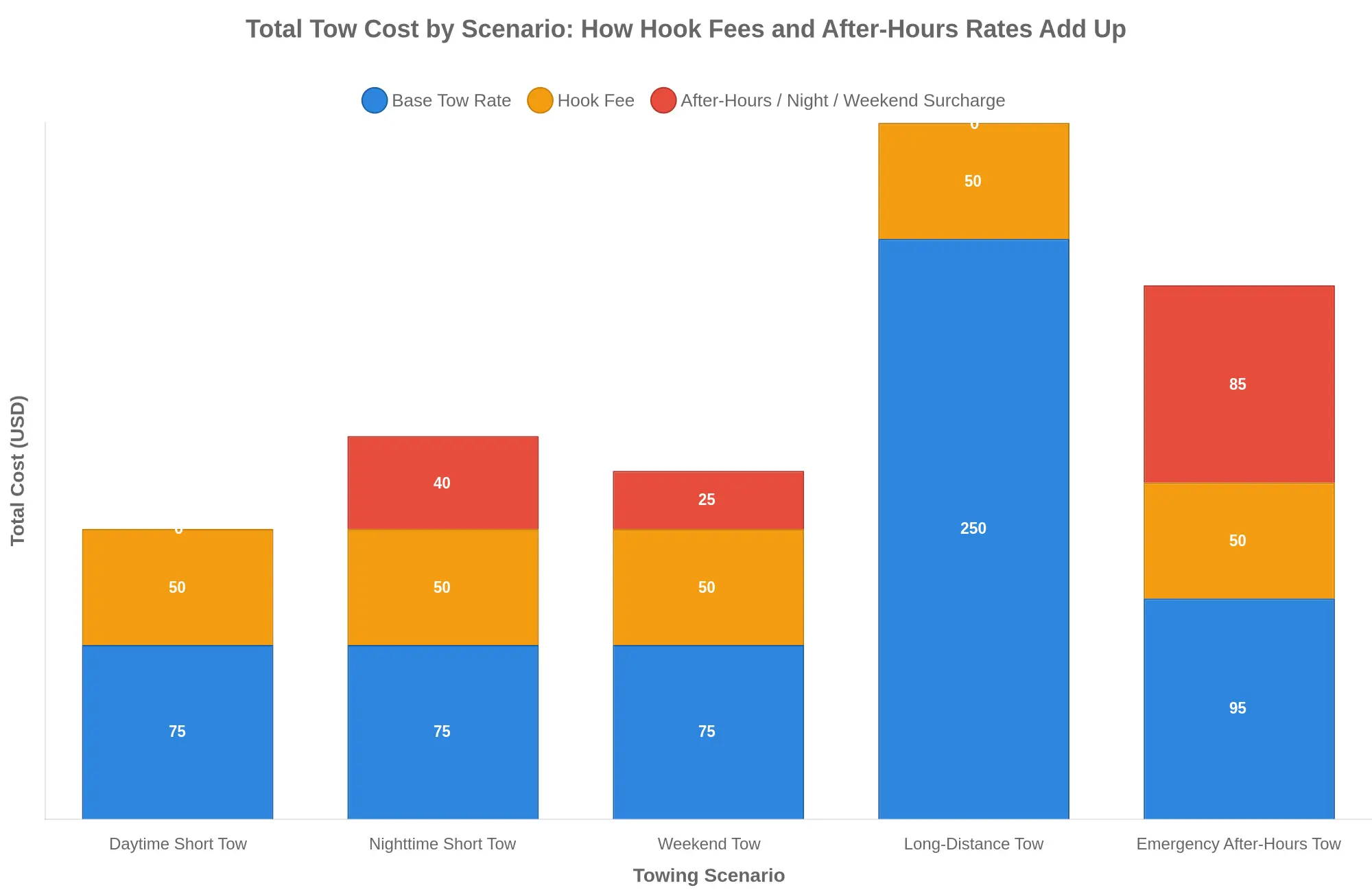
A quote of “$75 for a tow” rarely reflects the final bill. The chart below runs five common scenarios, showing how the hook fee and the after-hours rate stack on top of the base tow charge and push the total past what you were told.
Reading the Chart
Every bar is stacked in three layers:
- Blue – Base Tow Rate: the headline number a dispatcher usually quotes over the phone.
- Orange – Hook Fee: an almost universal add-on for attaching, lifting, and securing your vehicle. It rarely appears in the initial quote.
- Red – After-Hours / Night / Weekend Surcharge: the variable that punishes emergencies, turning a routine call into a premium one.
Distance is only part of the story. A Nighttime Short Tow totals $165 against $125 for the same service in daylight – a 32% jump created almost entirely by a single red block.
Three Takeaways for Cost-Conscious Drivers
- The hook fee is nearly fixed, so always ask about it. It appears on four of the five bars at the same $50 level, regardless of distance or time. If a quote omits it, treat that quote as incomplete.
- Timing is the biggest hidden multiplier. The emergency after-hours tow carries an $85 surcharge – more than the base rate itself for a short tow.
- Compare true totals, not headlines. A low base rate paired with a fat surcharge can cost more than a higher, all-inclusive quote. Before you commit, learn the traps behind cheap tow truck quotes so the number you agree to is the number you pay.
Use the chart as a checklist the next time you call: confirm the base rate, get the hook fee in writing, and ask whether an after-hours rate applies. Drivers who ask those three questions are the ones who avoid a surprise on the invoice.
The Most Common Hidden Fees in Low Cost Tow Truck Service
When a quote sounds too good to be true, the difference is usually hiding in line items you never see up front. These are the ones worth asking about before you sign:
- Hook fee – Charged the moment the operator attaches your vehicle to the truck. It is often left out of the initial phone quote.
- After-hours rate – A premium added for any call outside standard business hours, so a 2 a.m. breakdown on the shoulder can cost far more than the same tow at noon.
- Winch fee – Billed when your vehicle must be pulled out of a ditch, embankment, or snowbank using the winch cable rather than driven onto the flatbed, priced per foot or per pull.
- Cleanup fee – Charged to clear debris, fluid spills, or broken glass from the scene. Some jurisdictions require the site to be cleared, which makes this one easy to add without explanation.
- Storage fee – Accrues daily once your vehicle reaches the impound or holding yard, and it can quietly outpace the tow charge itself if you cannot retrieve the car quickly.
- Mileage surcharge – An additional per-mile rate applied beyond a base radius, which means the cheapest advertised starting price can balloon once distance is factored in.
- Gate or fuel fees – Flat add-ons for fuel fluctuation or for gaining access through a locked gate, gated community, or secure lot, tacked on without any transparent justification.
Each of these is legitimate on its own. The problem starts when they are buried instead of quoted. Ask the dispatcher to read the full fee schedule aloud, then confirm it in writing. For a closer look at how reputable operators price their work next to how discount outfits mask costs, review this guide to low cost tow truck service.
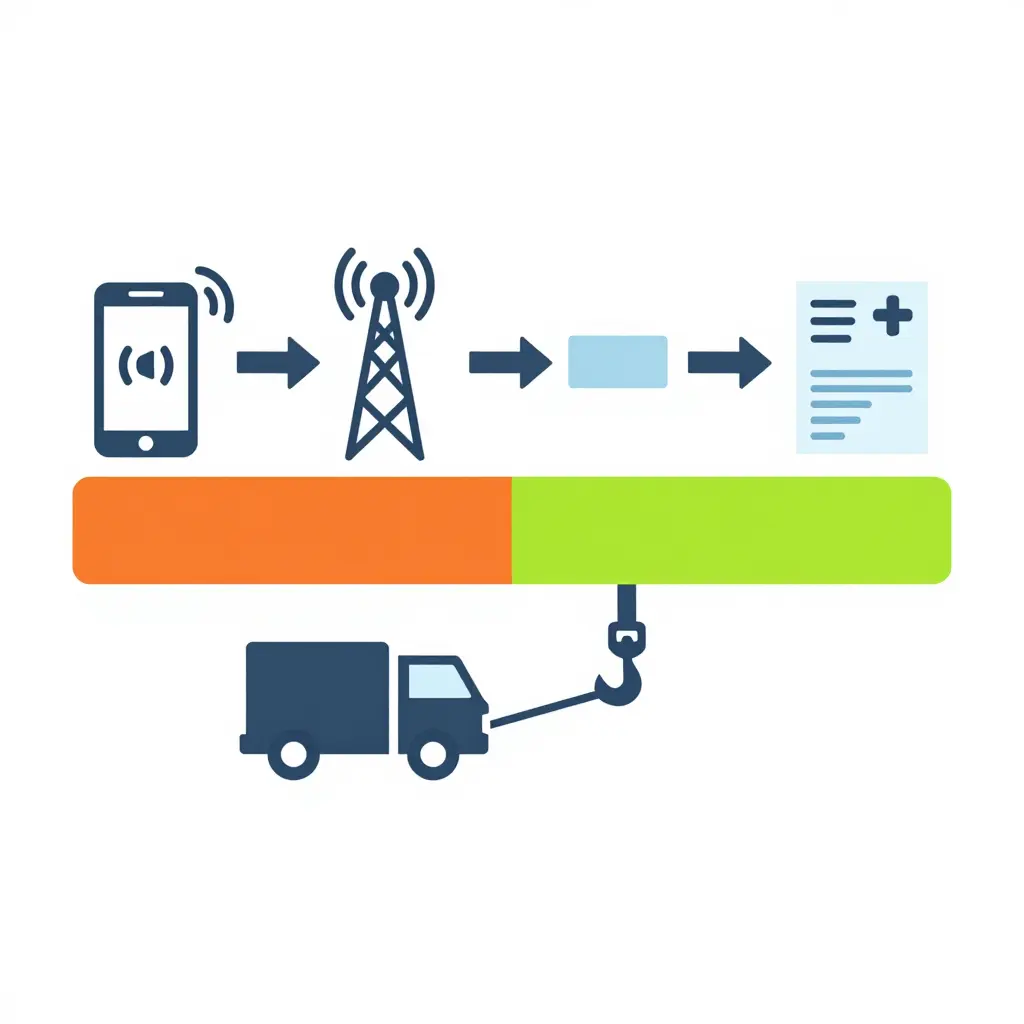
FAQ: Towing Fees, the Hook Fee, and the After Hours Rate
Hidden towing charges generate more consumer complaints than almost anything else on the road. Here is what drivers and fleet managers actually need to know.
Is a hook fee always charged?
No. A hook fee is a charge for the physical act of attaching your vehicle to the tow truck, and it is legitimate when it is disclosed up front and the work was actually done. Some operators use it as a catch-all add-on that appears even when a tow never happens – for example, a motorist who cancels on arrival. Reputable companies disclose the hook fee before dispatch, so always ask: “What is your hook fee, and is it charged if I cancel before you arrive?” Get the answer in writing, by text or email, before you authorize the tow.
Can the after hours rate be refused?
It can be challenged, but not always refused. The after hours rate is the premium added for service outside standard business hours, typically late nights, weekends, and holidays. If you genuinely called during those hours, the surcharge is usually valid. If the truck arrived at 3 p.m., an after hours rate should not be on the bill. Check the timestamp on your invoice against when the service actually happened; if they do not match, dispute it in writing and point to the discrepancy.
Why is my final bill higher than the quote?
Usually because the quote covered only the base tow, while the final invoice layered on add-ons: the hook fee, the after hours rate, mileage beyond a set radius, winching, storage, and “administrative” charges. A quote is not a fixed price unless the provider commits to it in writing. Protect yourself by requesting a written, all-inclusive estimate that itemizes every potential charge before the truck rolls. For a deeper look at how these numbers get buried, see our breakdown of the low cost tow truck service pricing trap.
How do I dispute hidden towing fees?
Dispute in writing, and do it fast:
- Request an itemized invoice. You are entitled to a line-by-line breakdown, not a lump sum.
- Compare it to your quote. Highlight every charge that was not disclosed beforehand.
- Pay the undisputed portion only. Paying in full can be read as acceptance.
- Put your dispute in writing and keep dated copies of texts, emails, and photos.
- Escalate to your state’s consumer protection office or transportation regulator if the operator refuses to adjust the bill.
Are cheap tow truck quotes ever legitimate?
Sometimes, yes, particularly for short local tows with a company that has genuine overhead advantages. But be skeptical when a quote is dramatically lower than every competitor. Rock-bottom pricing is often a bait tactic: the low number wins the call, then the hook fee and after hours rate inflate the final bill. A fair quote includes the base rate, mileage, and a clear statement of any surcharges. If a provider will not put that in writing, treat the price as fiction.
Bottom line: Demand written, itemized quotes, check the service timestamp, and never accept a verbal promise as a price. Those habits turn a surprise bill into a predictable one.
The Bottom Line: A Low Advertised Price Is Not the Same as a Low Final Bill
The lowest number on the sign is rarely the number you pay. When a company markets an unusually cheap rate, the missing money reappears somewhere else, and the two favorite hiding spots are the hook fee and the after hours rate. A quote that sounds like a bargain at 2 p.m. can double the moment the truck is dispatched at midnight, and a hook fee that is never mentioned up front turns a friendly figure into an unpleasant surprise on the invoice. That is the trick behind many alluring low cost tow truck service quotes.
Your power as a buyer is simple: you can refuse a verbal estimate that comes without details. An itemized written quote forces every line into the open, so you can see the base rate, the hook fee, mileage, and the after hours multiplier before anyone touches your vehicle. If a dispatcher hesitates to put it in writing, that hesitation is your answer. Drivers who want to understand how reputable shops handle overnight calls can see how professional tow truck companies run round the clock dispatch and compare it against the vague promises they are being offered.
Protect Yourself Before You Sign
- Ask for a fully itemized written quote, not a single lump figure.
- Confirm the hook fee separately from the base or service rate.
- Get the after hours, weekend, and holiday rates in writing.
- Ask about mileage, storage, and winch or recovery add ons.
- Request the total expected cost, in writing, before you authorize the tow.
- Keep a copy of the quote and compare it against the final invoice.