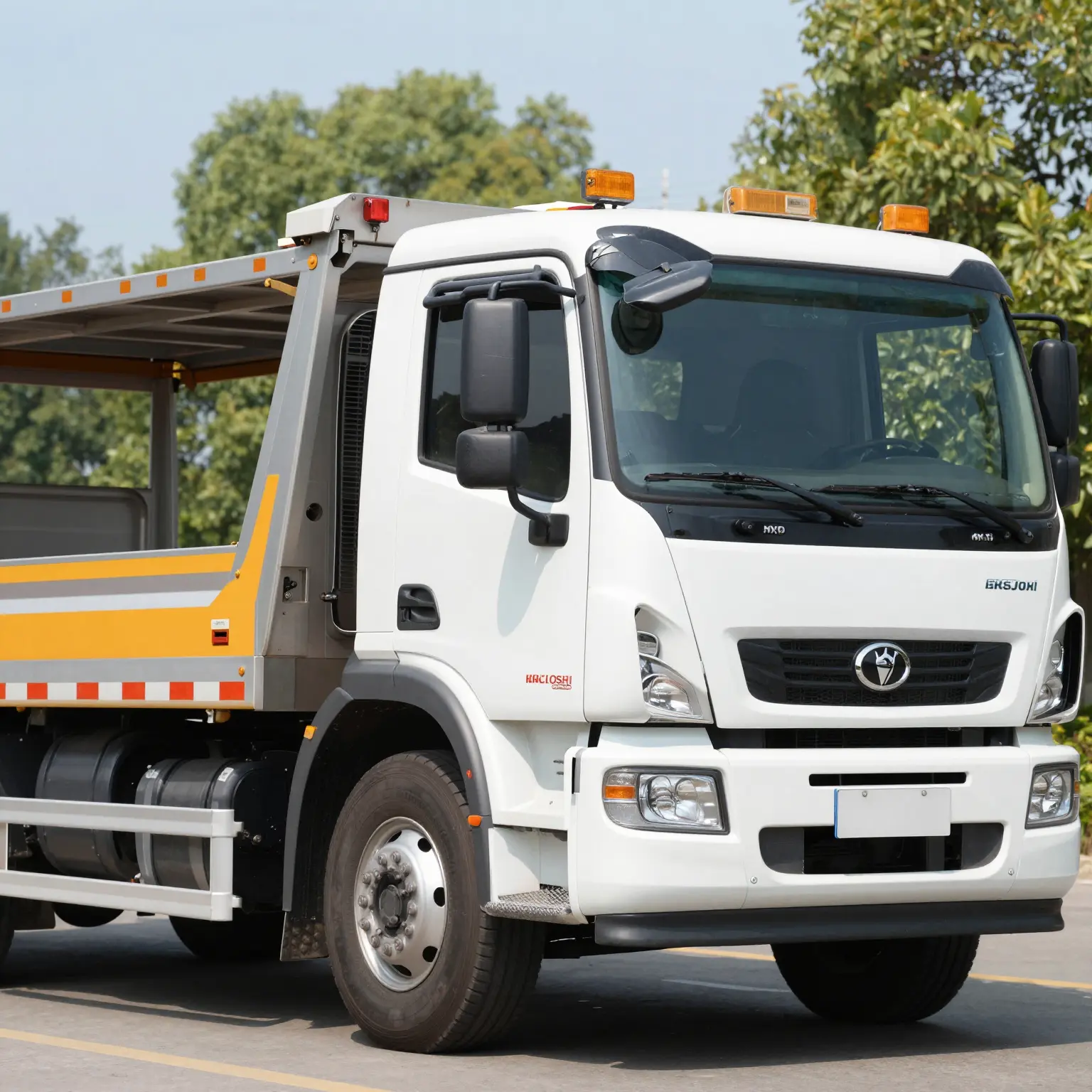

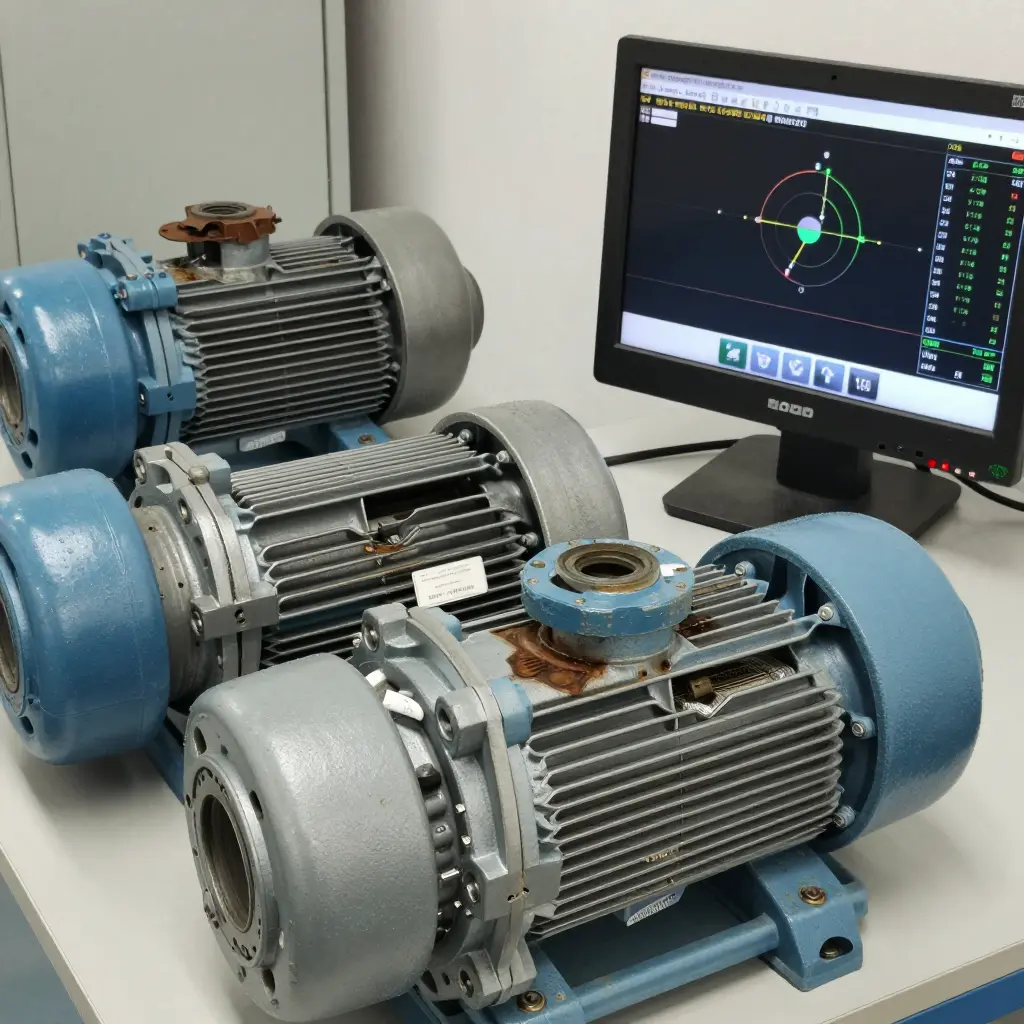
Telematics data is what your vehicles report on their own over a cellular or satellite link: GPS location, engine hours, coolant temperature, hydraulic pressure, fault codes, fuel use. It shows what a machine is doing right now and how its major systems behave as a whole. Early hydraulic pump failures are a different kind of problem. They begin inside the pump itself, with worn gear teeth, scratched piston bores, degraded seals, and contaminated oil, and they can develop for weeks or months before system output drops enough to set off an alert.
Telematics data frequently misses those early failures. Onboard sensors monitor system-level outputs: pressure, flow, temperature. They do not watch the internal wear that begins long before a fault code appears. A pump can lose a large share of its service life while every dashboard value still looks normal.
This matters to anyone who owns or services hydraulic equipment. Auto repair shops and technicians often see a pump only after it fails, when the customer is already stranded and the bill is large. Fleet managers pay for the same failure in other ways: downtime, roadside towing, and a truck that cannot earn. Choosing professional-grade hydraulic and lifting equipment raises the baseline at the buying stage, but it does not close the monitoring gap. For owners, shops, and fleet managers alike, the gap between what telematics reports and what is happening inside the pump decides whether maintenance gets planned or becomes an emergency.
The Progressive Failure Mechanism: Why Each Stage Hides in Plain Sight
Hydraulic pump wear rarely announces itself, and each stage sets up the next. The damage compounds while the data your telematics collects barely moves.
Stage 1 – Contamination Ingress. Every hydraulic system tolerates some particulate matter, usually tracked with ISO cleanliness codes. When a breather fails, a seal weeps, or a service event lets debris in, abrasive particles start circulating. System pressure and flow rate barely move at this point, so the pump looks healthy while the abrasive countdown is already running.
Stage 2 – Surface Scoring and Internal Leakage. Trapped particles migrate between the gear, vane, or piston surfaces and the wear plates, carving fine grooves into precision-machined faces. The scoring widens internal clearances, and fluid starts bypassing the pumping chamber instead of leaving through the outlet port. Internal leakage bleeds efficiency slowly. A pump running a few degrees hotter with slightly slower cycle times still lands inside normal operating bands, which is the gap that hydraulic system diagnostics exists to expose: flow loss, not pressure, tells the real story.
Stage 3 – Cavitation Pitting. Restricted inlet flow, aerated fluid, or high fluid temperature can pull local pressure below the fluid’s vapor point. Vapor bubbles collapse against the metal and pit the surface with localized micro-jets, tearing away material and accelerating the clearance growth from Stage 2. Cavitation usually makes noise, a whine or the rattle of aerated fluid, but vibration and temperature sensors tend to average those transients away, so no alarm sounds.
Stage 4 – Catastrophic Breakdown. Once clearances exceed design tolerances, the pump cannot build usable pressure. Internal leakage becomes total, heat spikes, and something breaks outright: a seized shaft, a cracked housing, a sheared drive. What began as a wearable part is now a full-system contamination event.
Telematics misses this progression for a structural reason: each stage changes pressure and flow only slightly, and the changes accumulate. Predictive maintenance programs work around it by pairing trend analysis with fluid sampling and targeted flow testing, so the decline gets caught while it is still a repair.
Early Warning Signs You Can Spot Without Telematics
Telematics platforms log duty cycles, oil pressure flags, and fault codes well enough. They rarely capture the physical cues that show up before a hydraulic pump fails. Technicians and operators who work the same truck every day usually notice these changes first, and none of them require a dashboard.
- Rising fluid temperature. A reservoir or hose running hotter than usual means internal wear is turning hydraulic energy into heat instead of work.
- Fluid discoloration. Dark, cloudy, or burnt-smelling oil points to oxidation and contamination, which speed up seal and bearing damage.
- Audible whine changes. A new whine, or a higher pitch under load, usually means the pump is struggling to draw or pressurize fluid.
- Declining cycle speed. A boom, bed, or winch moving slower than it used to means the pump is losing volumetric efficiency and delivering less flow per stroke.
- Increased aeration. Foamy oil or a chattering system means air is getting into the circuit, often past worn seals or through a low reservoir level.
- Metal particulate in the reservoir. Fine filings or a metallic sheen in the fluid is direct evidence of wear inside the pump and other components.
- Hot fittings and weeping seals. Warm couplings or small leaks that keep coming back mean pressure is escaping where it should be contained.
None of these signs needs a subscription, a cellular signal, or a clean data feed, which is why telematics does not report them. When one appears, book an inspection instead of waiting for a code to confirm what you already saw and heard. Catching a cue early is what turns a roadside failure into a planned repair.
For a wrecker fleet, hydraulic efficiency is what keeps trucks on the road. See how unlocking efficiency in wreckers and tow trucks pays off over the life of a vehicle.
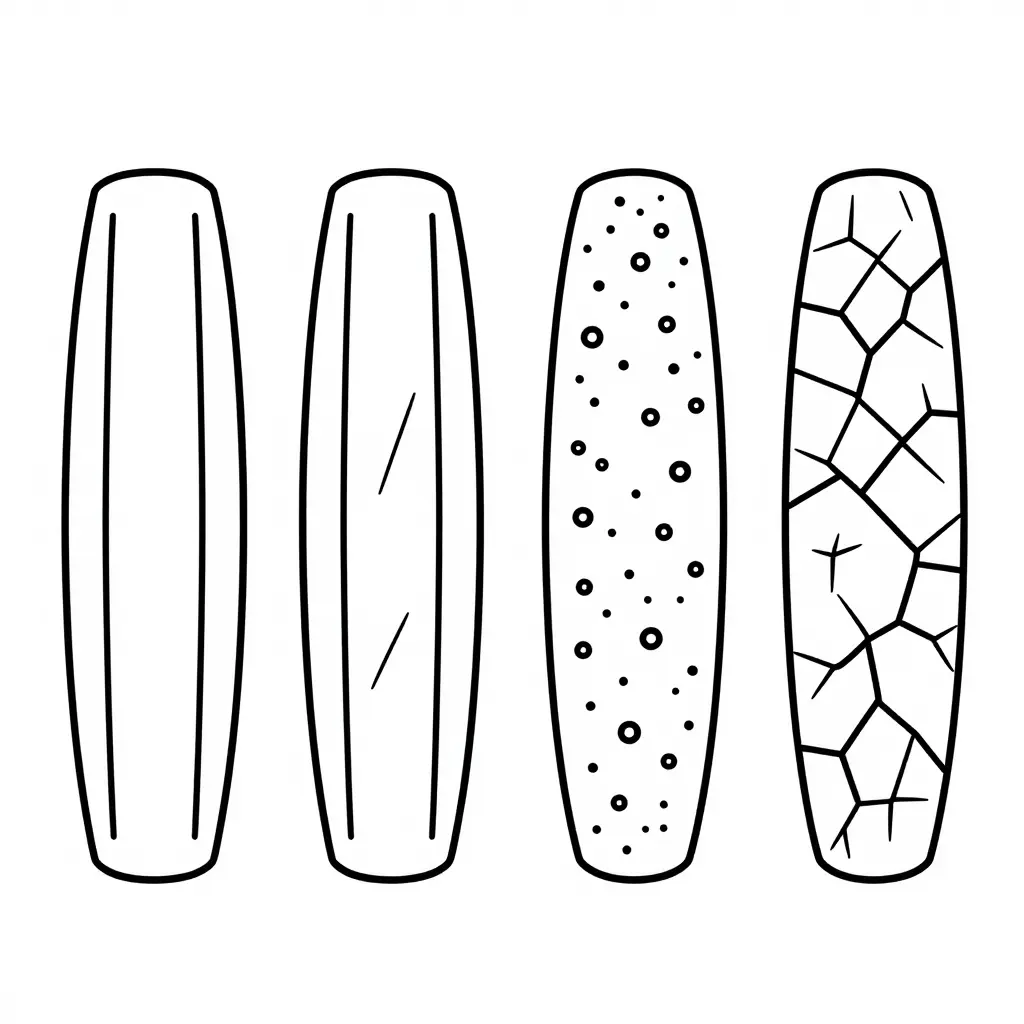
The internal wear telematics sensors cannot see: four stages that unfold inside the pump long before they register in external data.
The Architecture Blind Spot: Why Telematics Sensors Miss Early Hydraulic Pump Failures
Placement comes first. Most telematics sensors mount at the system level, not on the pump. They read overall hydraulic pressure, fluid temperature, or engine load for the whole machine, so each value reflects dozens of parts working together. A pump that starts to degrade internally produces pressure ripples too small to stand out from that crowd, and no sensor sits close enough to catch them.
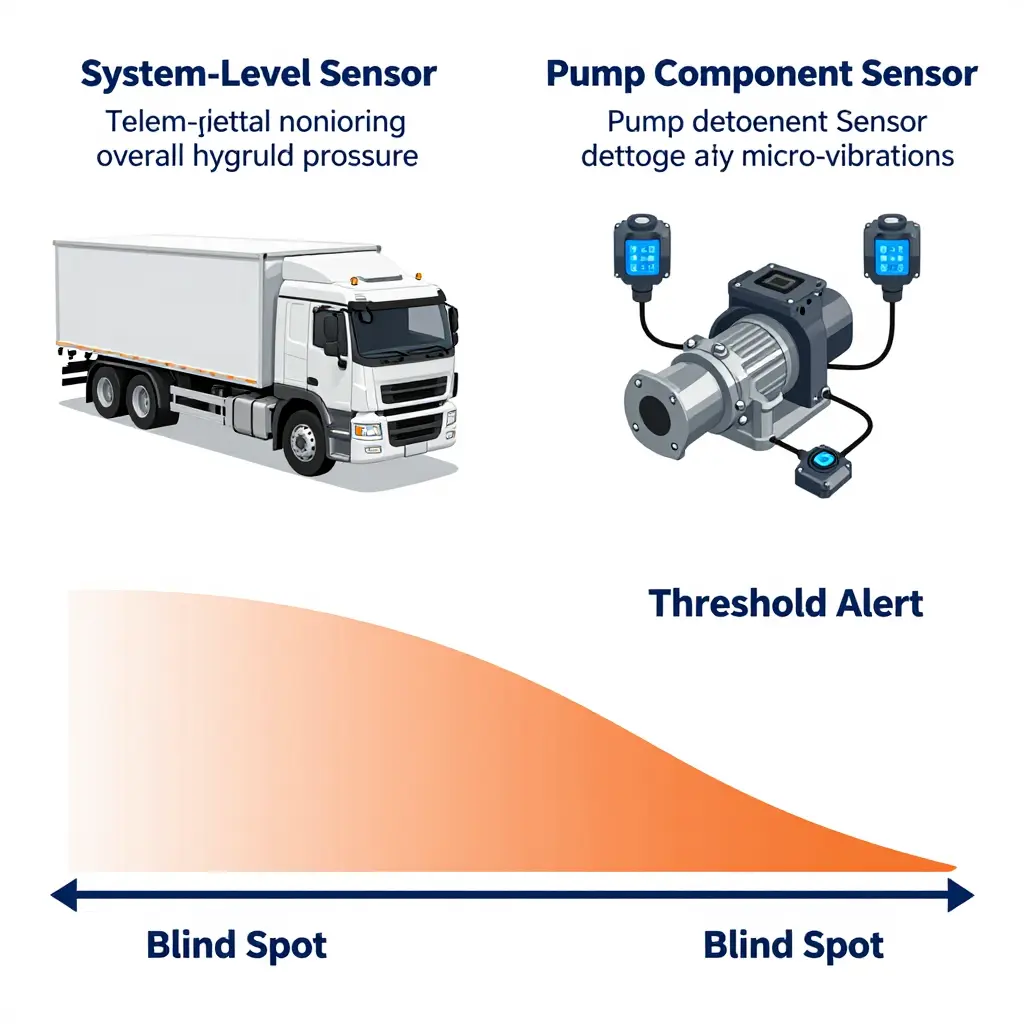
Sampling rate is the second problem. Many telematics systems log a reading every few seconds, or every few minutes, which is too slow for transient events. The cavitation, micro-vibration, and brief pressure spikes that mark the earliest wear can last only milliseconds. A slow interval steps right over them and records a healthy-looking number where a spike actually occurred.
Threshold-based alert logic makes it worse. These systems warn only when a value crosses a fixed limit, so the slow drift that defines early wear never registers. By the time pressure or temperature breaches the threshold, the pump is failing, not starting to fail. Good condition monitoring reads the trend, not just the drop at the end of it.
Data is also aggregated before transmission. Rather than streaming raw signals, most platforms compress readings into averages and send them in batches, which smooths away the irregularities diagnostics depend on. Those four design choices add up to a real blind spot for early hydraulic pump failures. Maintenance teams get their alert after the damage is done, and a repair that could have been scheduled becomes an unplanned breakdown. Smarter fleet efficiency planning starts with knowing where your monitoring stops seeing.
The table below maps what telematics systems actually report against the deeper internal failure indicators they routinely fail to catch in hydraulic pumps.
| Telematics Signal | What It Measures | Detection Timing | Failure Indicator It Misses |
|---|---|---|---|
| System pressure | Outlet line pressure (PSI/bar) at the pump | Only when pressure crosses an alarm threshold under load | Gradual volumetric efficiency loss and early cavitation onset |
| Hydraulic fluid temperature | Bulk oil temperature at the reservoir sensor | Lags real heat by minutes due to thermal mass | Localized hot spots from bearing wear and imminent seizure |
| Return flow rate | Flow returning to the tank | Flags only after a restriction or relief valve opens | Internal leakage past worn clearances and falling output |
| Fault codes | Hard electrical, sensor, and logic faults | Triggers after a component fails or a sensor trips | Mechanical degradation with no electrical signature |
| Fluid level | Reservoir level via float or sensor | Alerts only after a leak or consumption is significant | Internal bypass, aeration, and suspended wear debris |
These signals lag degradation because they report system-level symptoms, not the internal wear behind them. By the time pressure drops, temperature spikes, or a fault code appears, the damage is usually well advanced. Technicians and fleet managers running heavy tow trucks who rely on these cues alone are reading the aftermath.
Sampling Intervals, Transmission Latency, and the Hidden Detection Lag
Every telematics platform promises early warning, but a monitoring system knows only what it is told. Most fleets poll hydraulic data on a fixed cadence, one reading every few minutes or sometimes once an hour. Thousands of pump cycles pass unobserved in between. The controller averages, rounds, and compresses that activity into one number before it leaves the machine.
Transmission latency adds another layer. Each reading is queued, pushed over a cellular link, and stored until the next upload window. In poor coverage it can sit for hours. By the time a value reaches the dashboard, it describes a machine state that no longer exists.
Threshold logic decides the rest. Most alerts fire only when a reading crosses a hard limit or leaves a fixed nominal range. A pump losing efficiency gradually never trips that line, because the reported number still sits inside the acceptable band. Stack the three delays together and you get a detection lag between real wear and the moment anyone is warned.
Take a pump that has lost roughly 15 percent of its internal efficiency over six weeks. Output pressure, oil temperature, and flow still read “normal.” The controller is satisfied, the dashboard is green, and the truck keeps working. The unit is already heading for a hydraulic pump failure, and the signals that should show it are being smoothed, delayed, and ignored. Regular hands-on inspection still matters on a fully connected fleet, because the real-world efficiency demands placed on wreckers and tow trucks are harsher than any averaged sensor snapshot suggests. The chart below shows the gap: week after week, internal efficiency drops while every reported value clings to the top of the range, until the alert finally fires, weeks late.
Detection Lag: Telematics vs. Human Eyes
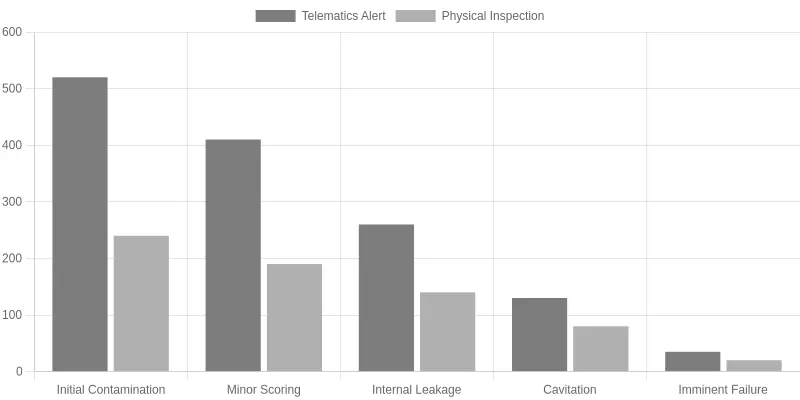
Even when telematics has the data, timing is the bigger problem. The chart below compares the two detection methods by how long each takes to flag a developing problem after a wear stage begins. Treat the figures as representative operating-hour estimates rather than measured averages from a controlled study. Hours are accumulated operating time, so shorter bars mean faster detection.
What the Numbers Tell You
In the early stages, telematics alerts lag physical inspection by hundreds of operating hours:
| Pump Wear Stage | Telematics Alert (hrs) | Physical Inspection (hrs) |
|---|---|---|
| Initial Contamination | 520 | 240 |
| Minor Scoring | 410 | 190 |
| Internal Leakage | 260 | 140 |
| Cavitation | 130 | 80 |
| Imminent Failure | 35 | 20 |
By the time the telematics alert fires, the pump is often in cavitation or near imminent failure, past the contamination stage a technician could have corrected cheaply. The lag shrinks as damage worsens, the reverse of how a warning system should behave. For shops and fleet teams running high-utilization equipment, that window decides between a fluid flush and a full pump replacement.
A skilled eye on the equipment still beats the sensor stack in the stages where intervention costs least, which is the reality your maintenance schedule has to account for.
The Three Blind Spots That Hide Early Hydraulic Pump Failures
Telematics platforms promise round-the-clock visibility, but the visibility has holes. In hydraulics, three of them let a failing pump pass the dashboard without a warning light.
Temperature sensors react too late. Most units flag a problem only after hydraulic oil has climbed well above its normal range. By the time a thermal alarm fires, the pump’s wear surfaces have been generating excess heat for hours or days. Heat is a symptom of damage already underway, not a predictor of early failure.
Vibration is barely monitored at the pump. Telematics units capture vehicle-level motion such as harsh braking or engine RPM, but they seldom track pump-level vibration continuously. The high-frequency signature of a degrading bearing or worn gear set stays invisible. Without vibration analysis feeding into hydraulic system diagnostics, technicians lose one of the earliest reliable indicators that a pump is on its way out.
Contamination is rarely tested in real time. Onboard systems almost never measure fluid cleanliness as it circulates. Particles, water, and metal debris build up gradually, and without live contamination data no one notices until filters clog or components seize. A manageable fluid problem becomes a pump replacement.
For technicians and fleet managers, these blind spots mean decisions based on incomplete data. A pump can pass every telematics health check while it approaches failure, so repairs stay reactive. Closing the gaps takes dedicated sensors and routine fluid testing, the only reliable way to catch problems early and keep trucks earning.
Catching Pump Degradation Before the Dashboard Ever Signals Trouble
Telematics data is a rear-view mirror for pump health. By the time a pressure-loss fault or overheating alert fires, wear has usually moved past the early window. Shops and technicians who want to catch degradation sooner need a hands-on routine that runs alongside whatever the modem reports. Telematics sets the schedule and raises the alarm; bench tools confirm what is happening inside the pump.
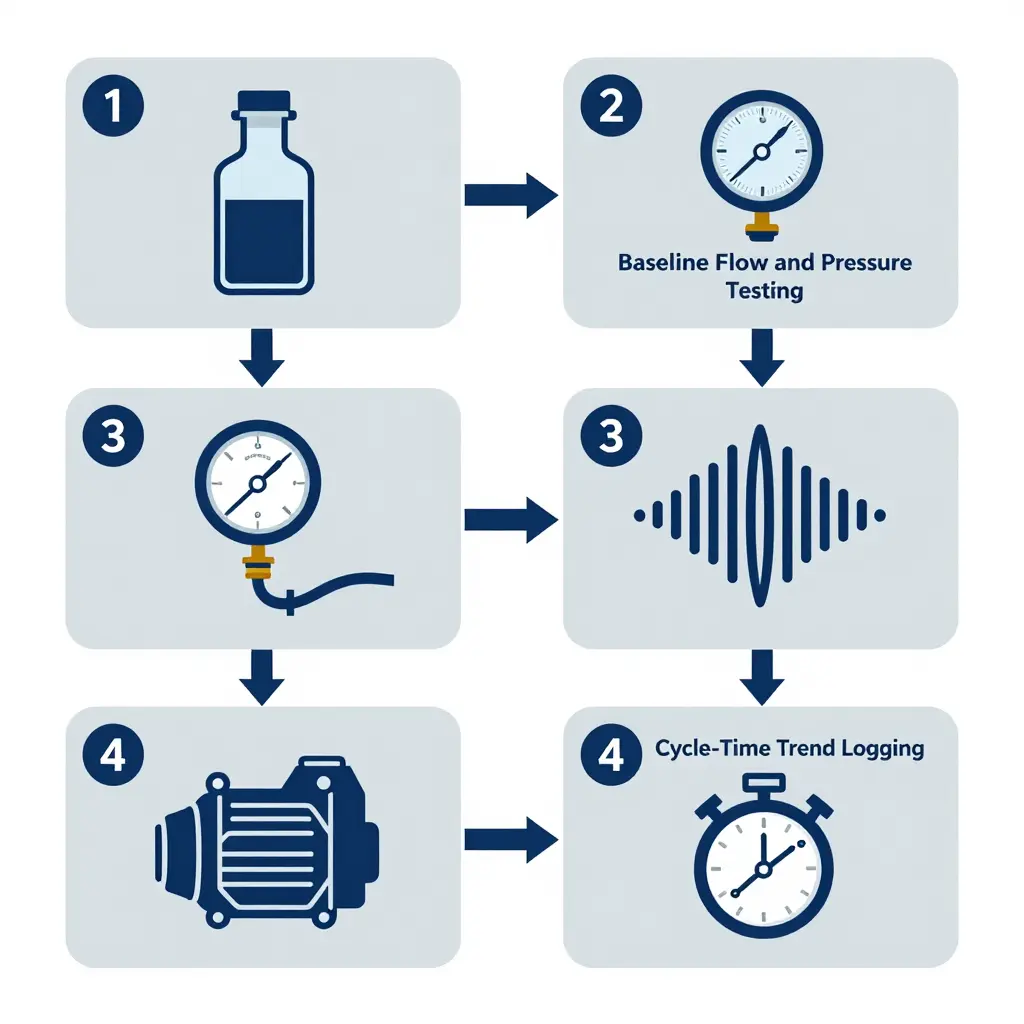
Start with periodic fluid sampling and lab analysis. Draw a small oil sample on a fixed interval, log the operating hours, and send it out for particle counting, viscosity testing, and wear-metal spectroscopy. Rising iron or bronze levels often show up weeks before performance drops. Pair the sampling with baseline flow-and-pressure testing: record clean results while the pump is healthy, then compare at every service, so a small slip in flow becomes a visible trend instead of a surprise.
Add vibration spectrum checks and cycle-time logging. A handheld analyzer spots bearing frequencies and cavitation signatures that telematics never surfaces. Logging cycle times, how long a lift or cylinder takes to complete a stroke, turns subtle slowdowns into data you can graph and schedule around. Together the readings make hydraulic system diagnostics proactive rather than reactive.
None of this replaces telematics; it sharpens it. With live data and physical measurements together, fleet maintenance teams can plan repairs on their own terms instead of reacting to a breakdown already in progress.
Pump Internal Health vs. Telemetry Readout Over Time
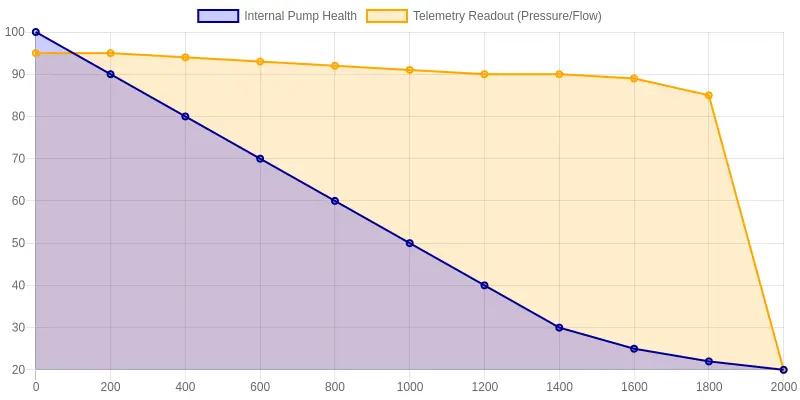
The Internal Pump Health line (dark blue) slopes from 100 down to 20 across the pump’s service life, tracking the slow wear of internal components. The Telemetry Readout line (orange) holds flat in the low 90s for nearly the whole timeline and collapses only near the end.
The gap between the lines is telemetry lag. Sensors watch pressure and flow at the system level, so as long as the pump moves enough fluid to meet baseline demand, the readout looks healthy. Wear inside stays invisible until the pump cannot keep up, and then the numbers drop all at once. By that point the failure is already underway.
A flat telemetry line is not proof of a healthy pump. It only means the pump has not yet crossed the threshold where worn internals show up in the numbers.
Where Hydraulic Pumps Fail in Tow Truck and Wrecker Fleets
Telematics flags the obvious well: a redlined temperature, a harsh braking event, a battery drifting below voltage. It rarely captures the slow decay inside a hydraulic pump, the kind that erodes a wrecker’s lifting authority long before a warning appears. For a fleet built on hydraulic equipment, that blind spot is expensive. A wheel-lift or boom losing pressure gradually never throws a code; it labors harder, runs hotter, and wears out sooner.
Hydraulic pumps on tow trucks and wreckers tend to fail in the same places. Heat is the main cause: as fluid temperature climbs, seals harden, clearances widen, and volumetric efficiency drops. Contamination makes it worse, because metal shavings from a worn cylinder travel through the system and scar the pump’s internals. On a heavy-duty semi tow truck, where the pump fights the greatest loads, both arrive fastest. Lighter rigs are not immune: a slow loss of pressure can push a unit past its rated towing capacity before anyone notices.
Different wrecker types demand different things from the pump, from continuous duty on a rotator to the stop-start cycling of a flatbed’s tilt. A reputable professional lifting special vehicle manufacturer designs for those stresses, but real-world duty cycles still find the weak points. Operators focused on unlocking efficiency in wreckers and tow trucks treat hydraulic health as a maintenance priority. Fluid analysis, temperature monitoring, and pressure testing catch the decay telematics misses, which pays off whenever you are investing in tow trucks, new or used.
Frequently Asked Questions: Telematics, Hydraulic Pumps, and Predictive Maintenance
Why does telematics data miss early hydraulic pump failures?
Telematics platforms track system-level signals: hydraulic pressure, fluid temperature, engine fault codes. Those trigger only once wear has advanced. Early pump failures begin as microscopic scuffing and contamination inside the pump, long before an external metric leaves its normal band. The alarm therefore fires after the useful window has closed, and shops end up reacting.
Can telematics ever predict pump failure?
Sometimes, but rarely early enough to act on. Careful alert tuning can expose slow pressure or temperature trends that hint at degradation, but the sensors sit far from the wear surfaces where failure starts. Telematics works best as one layer alongside fluid analysis and manual trending, not as a standalone predictor.
How often should we perform fluid analysis?
For most hydraulic systems, sampling every 250 to 500 operating hours, or at each scheduled fluid change, balances cost against coverage. Fleets running high duty cycles in dusty or hot conditions should sample closer to the 250-hour mark. Consistent intervals matter more than the exact number; a steady trend line is what exposes early wear.
Which parameters should we trend manually?
Watch pressure differentials, return-flow rate, fluid temperature, particle counts, and vibration signatures. They shift subtly as a pump wears, and plotting them over time reveals what a single snapshot or fault code hides. Manual trends plus telematics data give a clearer picture than either alone.
Does adding sensors help?
They help when they sit where the problem is: near the pump inlet, outlet, and case drain rather than at the reservoir. Poorly placed sensors add cost and noise without improving detection. Better placement plus disciplined fluid sampling does the most for any predictive maintenance plan.
What is the cost trade-off?
Fluid analysis and manual trending cost far less than an unplanned failure, which can idle a truck for days and damage downstream components. Basic programs run a modest fee per sample; sensor upgrades and telematics subscriptions add ongoing fees that only pay off if someone acts on the data. To get more from a maintenance budget, it also helps to review how efficient equipment management supports uptime.
How should shops and fleet managers build a practical routine?
Start with a fixed sampling schedule, log pressure, temperature, and flow at every service, and treat telematics as a backup alarm rather than the front line. Train technicians to compare trends against baseline data so small shifts prompt an investigation before a pump fails. Consistent habits beat expensive technology nobody monitors.
The Bottom Line: Telematics Is a Monitor, Not a Mechanic
Telematics data is useful, but it is a monitoring tool, not a diagnostic one. It watches system-level behavior well: fluctuating pressures, rising temperatures, engine load. It cannot perceive the microscopic wear that marks the earliest stages of a pump’s decline. By the time it flags a fault code, cavitation damage or seal degradation may already be advanced. The technology is not built to sense the problem where a fix costs least.
Telematics sensors sample at intervals built for fleet oversight, not component-level vibration or fluid chemistry. Pumps fail from the inside out: wear particles, fluid breakdown, and pressure ripple changes appear long before a threshold alarm triggers, which is how a log can read normal right up until a sudden failure. The gap is structural, not a matter of better software or more frequent alerts.
For auto repair shops and technicians, treat telematics as a first filter, then confirm with manual diagnostics, fluid analysis, and trend logging. For fleet managers, build a predictive maintenance program that pairs telematics with scheduled fluid sampling and manual inspection, an approach that fits naturally into improving wrecker fleet efficiency. Catching early hydraulic pump failures takes both the dashboard and the drain plug.